Search This Blog

Showing posts with label cosy. Show all posts

Thursday, 1 February 2018

Mini reviews #13

Gas Light (1938) by Patrick Hamilton. Describing itself as 'a Victorian thriller', Gas Light inspired the hugely successful Hitchcock film (which, amazingly, I haven't seen) and gave birth to the term 'gaslighting'. Until I read it, I didn't realise that the author also wrote the homoerotic psychological classic Rope. The play tells the extremely melodramatic story of a housebound wife in foggy London, who comes to believe that her husband is trying to drive her mad. The play is a hugely important precursor to the modern psychological thriller. However, even for a drama written 80 years ago, it feels slightly archaic in places; good, but more important than good.

Epitaph for a Spy (1938) by Eric Ambler. I'm incredibly impressed by my first taste of Eric Ambler. This early spy thriller, which is more of a detective story than later examples of the genre, stars a rather wonderful Hungarian immigrant, Josef Vadassy, who, taking his holiday snaps to be developed, discovers images of secret codes and weapons. Working with, but not really with, the French police, he stays in an hotel, knowing only that the enemy agent is among the other guests. The prose is fast-paced, funny, and, at times, beautiful. Although the culprit is fairly easy to spot, the denouement, on the rooftops of Toulon, is gripping.

Roseanna (1965) by Maj Sjöwall and Per Wahlöö. The first in the series from the couple who invented Nordic Noir. A beautiful American tourist winds up dead in Sweden (true life inspiration: Sjöwall observed Wahlöö eyeing up just such a woman, and resolved to kill her off in Chapter One). Out of their depth, the local police call in the troubled Martin Beck and his murder squad. Beck enters an intense and uncomfortable international investigation, uncovering sex crimes, persecution, and betrayal. A bleak and uncompromising story, Roseanna is a pioneering novel that has influenced most western crime writers since. Essential reading, still fresh and powerful today.

The Twelve Deaths of Christmas (1979) by Marian Babson. Last month, I was sorry to hear of Marian Babson's death in December, and reminded of the only book of hers I've read: the ridiculously titled The Twelve Deaths of Christmas. It's a diverting enough murder mystery, nothing more and nothing less. Set around an 'old-fashioned Christmas', the narrative perspective alternates rapidly and it's difficult to spot the killer. I haven't read it since I was eleven, but I remember very vividly a death scene on the London Underground. Babson herself was quite a character, who loved cats and never owned a television; if you have access to the CWA's Red Herrings, check out the tributes in the latest issue.

Beautiful Shadow: A Life of Patricia Highsmith (2003) by Andrew Wilson. Highsmith is the undisputed Queen of Suspense, an author we all want to know more about. Thankfully, Andrew Wilson's biography provides a detailed and nuanced account of her life and work. After reading this biography, I felt like I wanted to call Highsmith 'Pat', like I knew her in all her grubby, contradictory glory. It's not a happy story, but it's as compelling as anything she wrote.

Wednesday, 17 January 2018

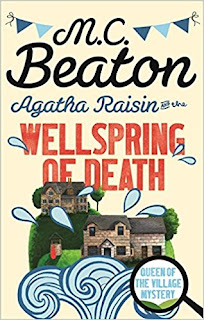
Agatha Raisin and the Wellspring of Death by M.C. Beaton

In 2014, I co-organised a conference in London: Queens of Crime, which focused on crime fiction and women. An astonishing number of delegates were middle-aged men, and they tended to tow a similar line: Agatha Christie was the Queen of Crime, PD James was just about acceptable, and Jessica Fletcher was a saint. On the first day, one gent -- a friend whose scholarly work I like and respect, but with whom I disagree on a couple of key points -- made a joke about M.C. Beaton, author of the Agatha Raisin mysteries, 'which are, of course, a waste of paper.' The room erupted with approval.

For the remainder of the conference, the idea that Beaton or Raisin could be considered crime queens, or even worthy of comment, became a running joke. An awful lot of energy was expelled on not giving these books the time of day.

I was a little confused. As I stated at the time, I didn't have a problem with the Agatha Raisin books; I quite liked them. There are a lot and I haven't read them all. I have also never tried Beaton's other series, Hamish Macbeth, or her romances written under the name Marion Chesney -- so, clearly, this series isn't engraved upon my heart, but it's okay. True, the books are not brilliantly written (okay, they are badly written), but these people were the kind who insisted that Agatha Christie just wrote puzzles, that literary quality was the last thing worth noting. So why all the hate? It was a mystery.

After checking Google to make sure that Beaton was not in fact a member of Britain First, I decided to just accept that lots of people didn't like the books, but that I wasn't one of them. After all, as an academic I'm used to being the only person in the room defending genre fiction of any kind, let alone a specific author. The hate continued at subsequent events; marvellous events with brilliant scholars, nearly all of whom I disagreed with on at least this one point.

When Sky announced an Agatha Raisin television pilot, and then a whole series, I was delighted. I came to the books through the radio adaptations with Penelope Keith, which change the tone considerably, so I wasn't surprised or disappointed to find the whole thing softened for TV. The other day, it was announced that Agatha Raisin would return for a second series. To honour this exciting news, I decided to review one of the books, and picked up an unread one at random from my bookshelf: Agatha Raisin and the Wellspring of Death (1998). Then, my eye fell on a publicity quote emblazoned on the back cover:
Agatha is like Miss Marple with a drinking problem, a pack-a-day habit and major man lust. In fact, I think she could be living my dream life (Entertainment Weekly).
And, just like that, all was clear. The hostility to the Agatha Raisin books has nothing to do with slap-dash writing. It's hostility towards Agatha Raisin herself. As an overweight, chain-smoking drinker solving twee English village mysteries, and actually taking the name Agatha (her maiden name is 'Styles', btw), she is desecrating the image of Miss Marple. Now, in my opinion, Miss Marple is a horrible person -- a great, loveable character, but an unkind person who uses gentility as a facade. That's my opinion and it's not a popular one. People like their older women detectives to be grandmotherly.

I, on the other hand, love Agatha Raisin. In the opening pages of The Wellspring of Death, she is lighting up her fifth cigarette of the morning when an uninvited houseguest asks her to put out her cigarette:
'Tough,' said Agatha. 'This is my house and my cigarette. What do you want?'
'Don't you know you are killing yourself?' 
Agatha looked at her cigarette and then at Mrs Darry.  'As long as I am killing myself, I am not killing you. Out with it. What do you want?'
Trust me, this is exactly how most smokers want to talk to helpful friends. So it's delightful to read about a fictional superhero who actually says the words.  Raisin, a retired PR manager, has moved to the Cotswolds for a slower pace of life. But she doesn't fit in and the locals have a nasty habit of bumping each other off when she's around. This is the seventh book in the series, so she has mellowed a little, but the city rudeness is still there.

However, as each book progresses, we learn that Agatha is in fact the most humane person in the village. She is naturally kind, while the polite and proper locals are cruel and out for themselves. At one point, a furious Agatha lets rip at the parish council, telling them: 'You're always like this, murder or no murder -- nasty, carping, vicious and bitchy.'

The plot here isn't really important, because the books are much of a muchness.  It all starts when the village next to Agatha's catches the eye of a high-falluting water company, which is planning to destroy the village spring for corporate ends. With hostility from the villagers brewing, a bored Agatha signs up as the company's PR spokesperson, but as soon as she has delivered her maiden polemic she stumbles over a corpse.

Agatha is reluctant to investigate, because she is busy with the PR job and her latest sexual conquest. Sleeping with a man half her age means she feels she has to pay more attention to her physical appearance than usual, and to shield herself from increasingly bitter village gossip. The relationship doesn't work out, as we know from the start that it won't. Meanwhile, Agatha's will-they-won't-they friend Colonel James Lacey flits in and out, getting jealous and saying nothing.

The whole tone is a bit smug and right-of-centre. Most village mysteries are, because most villages are. This is a world where the murderer can wrong-foot the detective by calling them 'a liberal', presumably the worst insult imaginable. Agatha herself is a bit right wing. There is a frankly hilarious description of evil left-wing environmental activists, clearly written by someone who has never met a left-wing environmental activist.

But underneath everything, as stated, the lead character is sympathetic and humane. She can register distaste and hurl insults (my favourite one from the radio is 'your imagination is as garish as your lipstick') but she understands that even bad people don't deserve to die. When the plot demands, she grows emotional. The first thing that puts her off her toy boy is when, upon discovering a second corpse, he decides to call the papers -- to make sure it's reported in a way that reflects his company well -- before calling the police. Agatha is outraged, and channels her energies appropriately.

The writing style is simple and straightforward. The author's mind seems always to be on other things, and she seems to be rushing to type 'The End.' The book was probably written in less time than it takes to read, and it took me one afternoon. But it does what it needs to do: it entertains, inoffensively.

Sunday, 17 September 2017

Crimes of Passion (Svensk Filmindustri)

Alternative title for this blog post: Unpopular Opinion Time!

Maria Lang (1914-1991) has been described as ‘Sweden’s Agatha Christie’ and although I haven’t read any of her work, I gather that she has a better claim to the title than Camilla Lackberg. A university professor (Lang was a pseudonym for Dagmar Lange), she was a prolific producer of traditional mysteries with occasional dark or provocative themes. Crimes of Passion (2013) is a set of six standalone films based on novels by Lang, designed as an antidote to Nordic Noir, with one eye firmly on the export market. Both at home and abroad, it was a spectacular flop. Here is the twist: I like the series.

As with each season of Wallander, the first 90-minute episode of Crimes of Passion was broadcast in Swedish cinemas, and subsequent instalments went straight to DVD. The mistake here was that the first episode is by far the worst. It is almost unbelievably boring, and it’s little wonder that the whole thing was panned on the strength of the first episode’s reviews. In fact, despite trying three times, I couldn’t make it to the end of this episode. I had to switch off two thirds of the way through. There is one very uncritical reason I persevered and tried Episode Two: because everything about the show is absurdly pretty and I like pretty things.

The series also flopped as a UK export. Broadcast late at night in 2014 on BBC 4, the station that picked up some of the grimmest gems of Scandi Noir, Crimes of Passion was sold to the public as ‘Mad Men meets The Killing.’ It isn’t. It just isn’t. It’s light, cosy, and nostalgic. It’s the opposite of The Killing. I can’t help but agree with the Guardian’s reviewer, Vicky Frost, who opined that there was nothing wrong with the series; it was just being sold to us in the wrong way and would be more at home on ITV 3 than non BBC 4. That said, I don’t think it would work on any ITV station unless it was remade in English, and I’m sure producers would find a way to cock that up.

Frost also takes the series to task for failing to pay more than ‘lip-service’ to ‘issues’:
When Lange first wrote her mysteries in the 50s, her inclusion of themes such as lesbianism, the suffocating reality of marriage for women, or the scandal of children born out of wedlock would have had real impact. Here, they are dealt with somewhat half-heartedly; Puck’s reservations about marriage dealt with by a cheery “Let’s do things differently!”. It feels more like lipservice to the era than, for instance, the serious questioning of society found in the Swedish crime-writing of Henning Mankell or Maj Sjowall and Per Wahloo. Which is all the more frustrating given that one of its detectives is, unusually, a woman.

I do not know if Frost has read Lang’s fiction — again, I haven’t, and I'd like to hear from someone who has, because I’d love to know how she handles these issues. All I know, from a bit of Googling, is that the inclusion of a gay male couple in her first novel caused a few eyebrows to arch. I also know that Puck in the books (I’ll explain who she is below, but she’s the star of the show) just acts as an assistant to the main detective, who is the policeman. I know she only appears in a few books before being married off and replaced. I don’t know if Lang ever tried to seriously tackle societal issues. Three of the books have been translated into English, and maybe I’ll get round to reading them one day … if you’ve read them, would you recommend them? At any rate, there’s an argument and a place for escapist crime fiction in most societies.

So much for context. When it comes to the programme itself, the first thing to note is that every scene, every costume, and every actor is ludicrously pretty. The set-up is this: a very attractive PhD student called Puck (Tuva Novotny), and her very very attractive boyfriend-then-husband Eje (Linus Wahlgren, whose idea of emotional range is varying shades of the same goofy smile), help a very attractive policeman called Christer to solve murders in a 1950s Swedish mining town. Christer is played by Ola Rapace, AKA Stefan Lindman in Wallander (2005). But in that series, he was angsty, aggressive, and troubled. Here, he is an avuncular pipe smoker whose biggest problem is working out which unsuitable woman to sleep with next.

As for the plots, I think they’re quite good. They’re not great, but each time there’s a steady central mystery with a reliable reveal and enough impact on the unfurling story of Puck and Eje’s evolving, then strained, relationship. It’s rather sad to see, in the final episode, that Puck becomes a published writer — because clearly this was the screenwriters paving the way to have Puck take a central role in future adaptations. In the later books, the character is replaced by Lang’s equivalent of Ariadne Oliver, an eccentric mystery novelist. Of course, there won’t be any more episodes. This doesn’t bother me too much: I’m not invested in Puck, Eje, or Christer. I deliberately chose to watch something light after ploughing briskly through all of The Bridge, all of Wallander (that ending was marvellous, wasn’t it, and brutal?), and most of The Killing. Well, Crimes of Passion, with its nebulous 1950s escapism, couldn’t be lighter.

Here is a summary of the six episodes, and my thoughts on each:
  1. Mördaren ljuger inte ensam (UK title Death of a Loved One) - lots of beautiful people are stranded on an island, then they start having sex and dying. I didn’t care for this one.
  1. Kung Liljekonvalje av dungen (UK title King Lily of the Valley) - a bride-to-be vanishes on her way to pick up her bouquet! WTF? Puck, Eje, and Christer work out who is lying (clue: it’s everyone). I don’t remember much of this one.
  1. Inte flera mord (UK title No More Murders) - Puck has married Eje, and now that he can’t say no, she gets a cat called Thotmes III, which promptly runs away and into a corpse, more or less in their back garden. Then a leading crime writer disappears. This was my favourite episode, partly because it was so much fun, partly because there was some genuinely interesting stuff about sexual ethics, and partly because ‘flera’ is my favourite Swedish word. 
  1. Rosor, kyssar, och döden (UK title Roses, Kisses, and Death) — something to do with seances, and another unsuitable girlfriend for Christer. I found this episode boring, and fell asleep watching it.
  1. Farliga drömmar (UK title Dangerous Dreams) — Puck becomes a stenographer for a Nobel prize winning novelist, who turns out to be rather mean. Then people start dying, and Puck starts to wonder why she was hired in the first place. This is a marvellously creepy episode with a locked-room feel (although the room is in this case the novelist’s highly-secure country estate). I would recommend this one.
  1. Tragedi på en lantkyrkogård (UK title Tragedy in a Country Churchyard) — This is a ‘busy’ episode, as it’s trying to round up the series while keeping things open for more. It’s set at Christmas where a family celebration at the vicarage is disrupted by a missing person who proves to be a not-very-missing corpse. Eje is pretty useless in this one — he just swans around getting tempted by a glamorous widow — so Puck teams up with a little girl (who is, amazingly, well played by a non-annoying child actor). That character, who devours crime fiction including Maria Lang’s Inte flera mord!, reminded me of Josephine in Agatha Christie’s Crooked House. But there the similarities end. While I liked Tragedy in a Country Churchyard very much, one thing that irritated me was the fact that everyone was smiling in every scene. It’s like the director reminded the cast between takes that this was supposed to be light and frothy. So we have Puck and Christer flirting over a corpse, and grinning broadly as they describe just how the axe was wielded, and how the young girl nearly stepped in his blood. Weird.
No one gives a spectacular performance in Crimes of Passion and I don’t know if the screenwriters have done Lang justice or not, but the scripts are okay. The whole thing remains consistently watchable. If I was a knitter, this would be the perfect programme to knit in front of. It’s absolutely everything  people think ‘cosy crime’ is: entertaining, easy, and a bit pointless. If there had been more episodes, I would have watched them for sure, but I’m not deranged with grief that the show was cancelled.